
That pulled-in-two feeling is exactly what Internal Family Systems (IFS) therapy was built to work with. IFS tends to see indecision as parts of you wanting different things, each one trying to protect you in its own way. So can it help people who feel conflicted about their decisions? Often, yes – though not for everyone, and never as a shortcut.
Anyone who's spent time on this site knows health choices get heavy. A treatment plan, another round of wound care, how much to take on as a caregiver. Decisions like these can follow you around for weeks. The same goes for considering who IFS therapy is for and who it may not suit, especially when deciding whether this approach is right for your emotional well-being.
TL;DR Quick Answers
Who Is IFS Therapy For? (And Who It May Not Suit)
IFS therapy tends to suit adults who feel pulled in two directions and already understand why, yet still feel stuck. It's usually a weaker starting point for anyone in crisis or who needs fast, structured tools. Fit and timing matter more than the model.
Often a good fit:
Torn decision-makers: You feel both sides of a choice strongly, sometimes in the same minute.
Insight without relief: You can explain your pattern, but understanding it hasn't changed it.
Push-pull relationships: You want closeness and distance at the same time.
A loud inner critic: Arguing with it hasn't helped.
Stalled past therapy: Other approaches helped a little, then stopped moving.
May not suit, at least not yet:
Crisis or safety concerns: Immediate support through 988 comes first.
Active substance use: Other approaches usually work better for starting recovery.
Psychosis or severe dissociation: Talking about "parts" can confuse more than help.
A need for structure or speed: CBT, DBT or practical problem-solving may fit better.
Conflict centered on someone else: Couples or family work may be needed.
Bottom line: IFS works with the parts of you that disagree instead of picking a winner for you. The research is still young, so a short consultation with a trained IFS therapist is the most honest way to check fit.
Top Takeaways
Feeling torn isn't a character flaw. IFS reads it as parts of you with different protective goals.
IFS tends to fit repeat patterns. It's most useful when insight and pros-and-cons lists haven't loosened the knot.
Timing matters. Crisis, active substance use or psychosis usually call for a different starting point.
The evidence is early. Pilot trials look promising, and no study has tested IFS on indecision directly.
Medical choices need both kinds of help. IFS can support the emotional side while your care team handles the medical side.
Why Feeling Torn Usually Means Two Parts Want Different Things
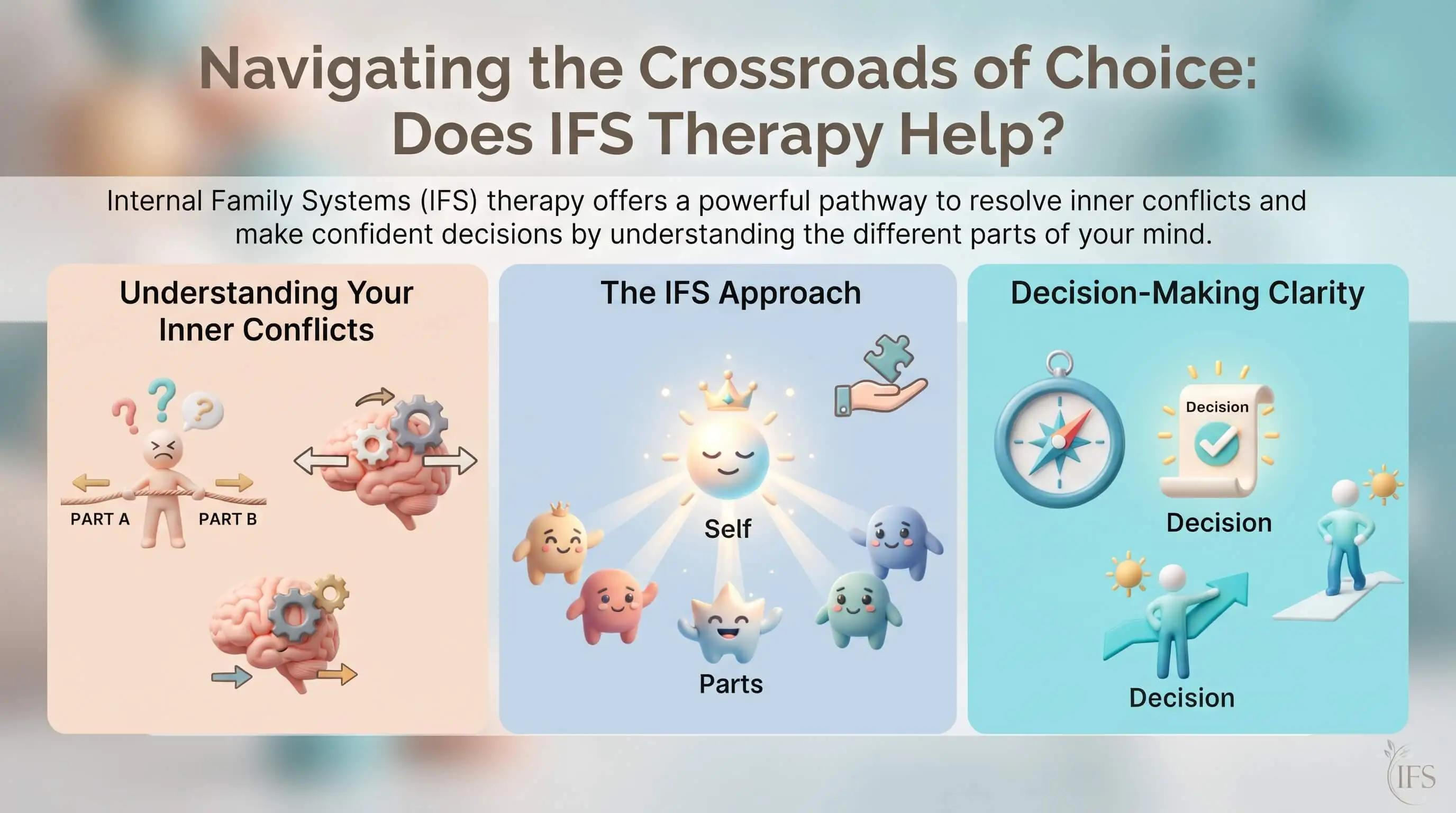
IFS treats indecision as a conflict between parts rather than a flaw in your character. Therapist Richard Schwartz developed the model in the 1980s, and it describes the mind as a set of parts led by a calm, curious center called the Self.
Most people already talk this way without noticing. "Part of me wants the job. Part of me wants to stay put." IFS just takes that sentence seriously.
When two parts dig in on opposite sides, IFS calls it a polarization. The cautious part remembers what happened the last time you took a risk, and it would very much like that not to happen again. The bolder part is tired of waiting and worries your life is getting smaller. Both think they're keeping you safe, and neither one is the villain.
This is usually why a pros-and-cons list doesn't settle anything. The list talks to your thinking mind, while the parts doing the arguing are often carrying fear or an old loyalty to someone. You can win the argument on paper and still feel frozen.
Think of a committee where everyone has a veto and nobody trusts the chair.
How IFS Works With Inner Conflict Around A Decision
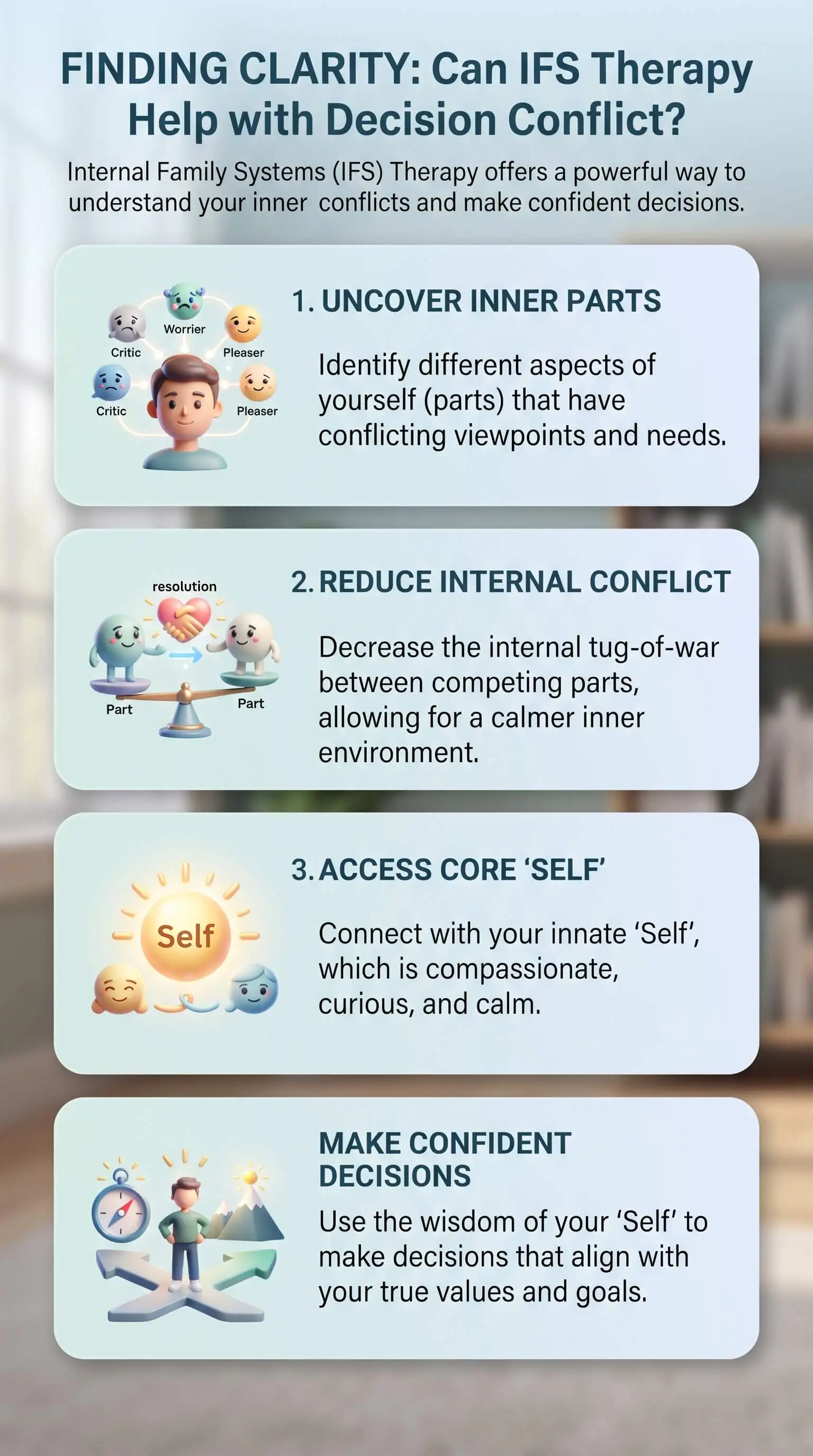
IFS won't hand you an answer. What it does is help you get to know the parts in the debate, so the decision comes from you and not from whichever part happens to be loudest that week. The work tends to move through a few stages:
Noticing the parts: You name the sides out loud. "There's a part that's scary, and another part that's angry I keep stalling."
Stepping back: IFS calls this unblending. "I'm terrified" becomes "a part of me is terrified," which is a lot easier to sit with.
Getting curious: You ask each part what it's afraid would happen. The cautious one might be guarding against regret, while the bold one might be guarding against a life that feels too small.
Letting the Self lead: As the parts settle, people often describe feeling calmer and clearer. IFS says that a steadier place is where good decisions come from.
Choosing with everyone heard: You still have to pick. The parts you didn't side with often stop fighting the choice afterward, and that's the difference.
A lot of this happens through feeling and imagery rather than analysis. People who expected to spend an hour talking through their options are sometimes surprised by that.
Who Is IFS Therapy For? Signs It May Fit Your Decision Struggles
IFS therapy tends to fit people whose indecision is a pattern, not a one-off. If a few of these sound familiar, parts work may be worth a closer look:
You feel both sides strongly: Sometimes within the same minute.
Insight hasn't moved anything: You can explain exactly why you're stuck, and you're still stuck.
Closeness swings back and forth: Move in or pull back, call or don't call, and the answer changes by the day.
Old family rules still get a vote: Rules you picked up as a kid still shape your choices, even when the adult disagrees with them.
A critic grades every option: It tears each option apart before you've even made it.
Lists and advice haven't helped: Pros and cons, a friend's opinion, maybe even past therapy, and the knot is still there.
Lauren Rath's guide to who IFS therapy is best for goes through each of these in more depth, including what a session actually looks like.
Who IFS Therapy May Not Suit (Or Not Yet)
A good IFS therapist will tell you when it isn't the right first step. That's a question of fit and timing, and it says nothing bad about you. IFS may not be the place to start if:
You're in crisis or don't feel safe: Immediate support comes first. Call or text 988 to reach the 988 Suicide and Crisis Lifeline at any hour.
You're actively using substances to cope: Other approaches are usually better at starting recovery, and parts work can come later.
You're experiencing psychosis or severe dissociation: For some people in these situations, talking about "parts" can be confusing or unhelpful.
You want worksheets and a clear plan: CBT or DBT will probably suit you better.
The decision is due Friday: IFS is rarely quick, so practical problem-solving helps more with a hard deadline.
The conflict is mostly with someone else: If the real sticking point is a partner or parent, couples or family work may need to be part of it.
If you're facing a medical choice, one more thing. IFS can help with the fear and second-guessing around a treatment decision, but it doesn't replace what your care team tells you. The two kinds of help work best side by side.
How IFS Compares With Other Approaches To Decision Conflict
Four common approaches look at ambivalence quite differently.
IFS therapy: Sees being torn as parts with protective jobs pulling in different directions. Sessions are experiential and open-ended, and it often suits recurring stuck patterns with older roots.
CBT: Treats indecision as thoughts and beliefs you can examine and test. Expect structure and usually some homework. It's often a good match for anxious or catastrophic thinking about choices.
DBT: Focuses on strong emotions that crowd out clear thinking, through skills training alongside individual sessions. It's often used for intense emotions and impulsive decisions.
Motivational interviewing: Sees ambivalence as a normal stage before change. It's usually brief and centered on one specific behavior you're deciding whether to change.
What The Research Says, And What It Doesn't Yet
The evidence for IFS is encouraging, and it's still early. The IFS Institute's research summary says as much, noting that the research base is limited and that larger, fully powered trials are needed for each condition.
What the summary does report is worth knowing. Depression is the only mental health outcome to show statistically significant improvement across multiple pilot randomized controlled trials. Several studies also show gains in self-compassion. A 2013 randomized trial with rheumatoid arthritis patients found reduced pain and depressive symptoms, and trials with people living with PTSD are under way.
Then there are the gaps. Nobody has published a study testing IFS on indecision itself, and the IFS Institute points out that no one has systematically studied the risk of harm yet. So when this page says IFS may help you feel less torn, that's based on how the model works and what clinicians see in practice rather than on a decision-making trial.
“When someone tells me they can’t make a decision, I’ve learned not to start with the options. I start with who’s arguing. There’s usually a part trying to keep them safe and another part worried their life is getting smaller, and both have been at it for months. What I’ve watched happen in the room is fairly consistent. Once each side feels heard, the decision tends to get quieter. It doesn’t always get easier, and I won’t pretend the research has proven any of this yet. But quieter is often enough to move.”
Essential Resources
IFS Institute: Find A Professional: Search for practitioners who've finished at least Level 1 IFS training, by location and availability. Practitioners report their own credentials, so double-check them before you book.
Parts Work Therapy: What It Is And How It Works: Lauren Rath's plain-language walk-through of parts, what sessions are like and where the research still falls short.
988 Suicide And Crisis Lifeline: Free, confidential support any time of day or night, by call, text or chat.
NAMI HelpLine: Information and referrals from the National Alliance on Mental Illness, weekdays from 10 a.m. to 10 p.m. ET.
FindTreatment.gov: SAMHSA's confidential search tool for mental health and substance use treatment across the U.S.
How To Choose A Psychologist (APA): The American Psychological Association's guide to vetting a therapist, including which questions to ask up front.
Washington State Provider Credential Search: The Department of Health's official lookup for checking a Washington provider's license and any disciplinary history.
Statistics
Close to two in three U.S. adults report at least one adverse childhood experience. CDC survey data from 2011 to 2020 put the figure at 63.9%, with 17.3% reporting four or more. In IFS terms, early experiences like these are often where protective parts first took on their jobs. Source: CDC, MMWR 2023
Only about half of adults with a mental illness get treatment. In 2022, an estimated 59.3 million U.S. adults (23.1%) had any mental illness, and 50.6% of them received mental health treatment in the past year. Source: National Institute of Mental Health
One early IFS trial checked results a full year after treatment ended. In a 2013 randomized trial, researchers assigned 79 adults with rheumatoid arthritis to either nine months of IFS-based group work or an education group. Gains in self-assessed joint pain were still there a year later. Source: The Journal of Rheumatology
Research shows that adverse childhood experiences are common, many adults with mental illness go untreated, and early IFS studies suggest potential benefits. A freelance healthcare content writer can help communicate these findings clearly, making IFS therapy research more accessible to people exploring emotional healing and mental health support.
Final Thoughts And Opinion
Feeling torn usually means you care about more than one thing, and each part of you is guarding something real. It's worth listening to before you try to shout it down.
My honest opinion is that IFS is one of the more useful tools out there for people whose indecision keeps coming back, especially when understanding the pattern hasn't changed it. I'd be more cautious about it for a fast, deadline-driven choice, or for someone who needs stabilizing first. The research is encouraging but young, and I'd rather say that up front.
If you're curious, finding out costs very little. A short consultation with a trained IFS therapist will tell you more about fit than any article can, this one included.
Frequently Asked Questions
Can IFS Therapy Help With Indecision?
For many people, yes, especially when the same kind of decision keeps getting stuck. IFS helps you understand the parts pulling in opposite directions and what each one is afraid of. Once those parts feel heard, choosing often gets easier, and so does sticking with the choice.
Who Is IFS Therapy Not Recommended For?
It may not be the right first step for someone in crisis, someone actively using substances to cope, or someone experiencing psychosis or severe dissociation. It can also be a weaker fit if you want a structured skills program. A trained therapist can help you judge fit before you commit to anything.
Will An IFS Therapist Tell Me What To Choose?
No. An IFS therapist helps you get to know the parts in the debate and stays out of picking a side. The aim is for the decision to come from your Self, the calmer and clearer center IFS describes, instead of whichever part is loudest that day.
Is IFS Therapy Evidence-Based?
The evidence is growing, and it's still limited. Pilot trials show improvements in depression and self-compassion, and a 2013 randomized trial found benefits for people with rheumatoid arthritis. Larger trials are still needed, and no study has looked at decision-making specifically.
How Long Before IFS Helps With A Hard Decision?
It depends. Some people feel clearer within a few sessions, because simply naming the parts takes some pressure off. When a decision ties back to older experiences, the work usually takes longer. If you're up against a firm deadline, ask your therapist about pairing IFS with practical decision steps.
Can I Try Parts Work On My Own For Small Choices?
In a light way, yes. Noticing "a part of me wants this, and a part of me wants that" and getting curious about each side can ease everyday indecision. When a decision is tangled up with painful memories or strong emotions, a trained therapist is the safer route.
Can IFS Help With Stress Around Medical Treatment Decisions?
It can help with the emotional side, like guilt or second-guessing about a procedure or a caregiving choice. It doesn't replace medical advice. Most people do best leaning on their care team for the medical facts and a therapist for the inner conflict.
Does Online IFS Therapy Work?
Many IFS therapists offer sessions by video. Lauren Rath, who works with adults online across Washington State, puts it this way: "In my experience, yes, and often better than people expect." A quiet, private room during sessions helps a lot.
Not Sure Whether IFS Fits You?
There's no rush to decide. If you're an adult living in Washington State, Lauren Rath offers a free 15-minute consultation to talk through whether IFS makes sense for what you're carrying, with no pressure and nothing to commit to.
Outside Washington, the IFS Institute's practitioner directory lists trained therapists by location. Talk to a few people if you want to, since the right fit matters more than finding one fast.


