
Write the most accurate health article on the internet, hit publish, then watch it sit on page three while a thinner post outranks it. I’ve seen it happen more times than I’d like. Healthcare is the most heavily scrutinized category Google has, and here’s what trips up most writers working in medical healthcare copywriting services: accuracy alone won’t get you found. The writers who actually rank pair medical knowledge with SEO that does its job. What follows are the practices I lean on every week to put health content in front of the people searching for it, and now, to get it cited inside the AI answers too.
TL;DR Quick Answers
Freelance Healthcare Content Writer
A freelance healthcare content writer is a contract writer who creates health content for clinics, practices, and health brands, from blog posts and web pages to patient education and email. A strong one does three jobs at once:
Research the medicine, so every claim holds up.
Writes in plain language, so patients actually follow it.
Builds in SEO, so the page ranks and gets found.
Unlike a medical writer, who produces clinical and regulatory documents, a healthcare content writer writes for patients and for search, so the practice gets found and books more appointments.
Top Takeaways
Accuracy gets you into the game. Search intent, E-E-A-T, and clean structure are what actually earn the ranking.
Read the live search results before you write. They tell you what format and depth the search really wants.
Show experience and credentials on the page itself: named bylines, visible dates, and citations to primary sources.
Optimize your titles, headings, and keywords naturally, then stop. Over-optimized health content tends to slide.
Build every page so a straight answer sits near the top, ready for featured snippets and AI summaries.
When the stakes are high, hiring help is the smart move. An experienced freelance healthcare content writer brings medical fluency and SEO judgment to content that has to rank and convert.
How Healthcare Content Writers Earn Better Rankings
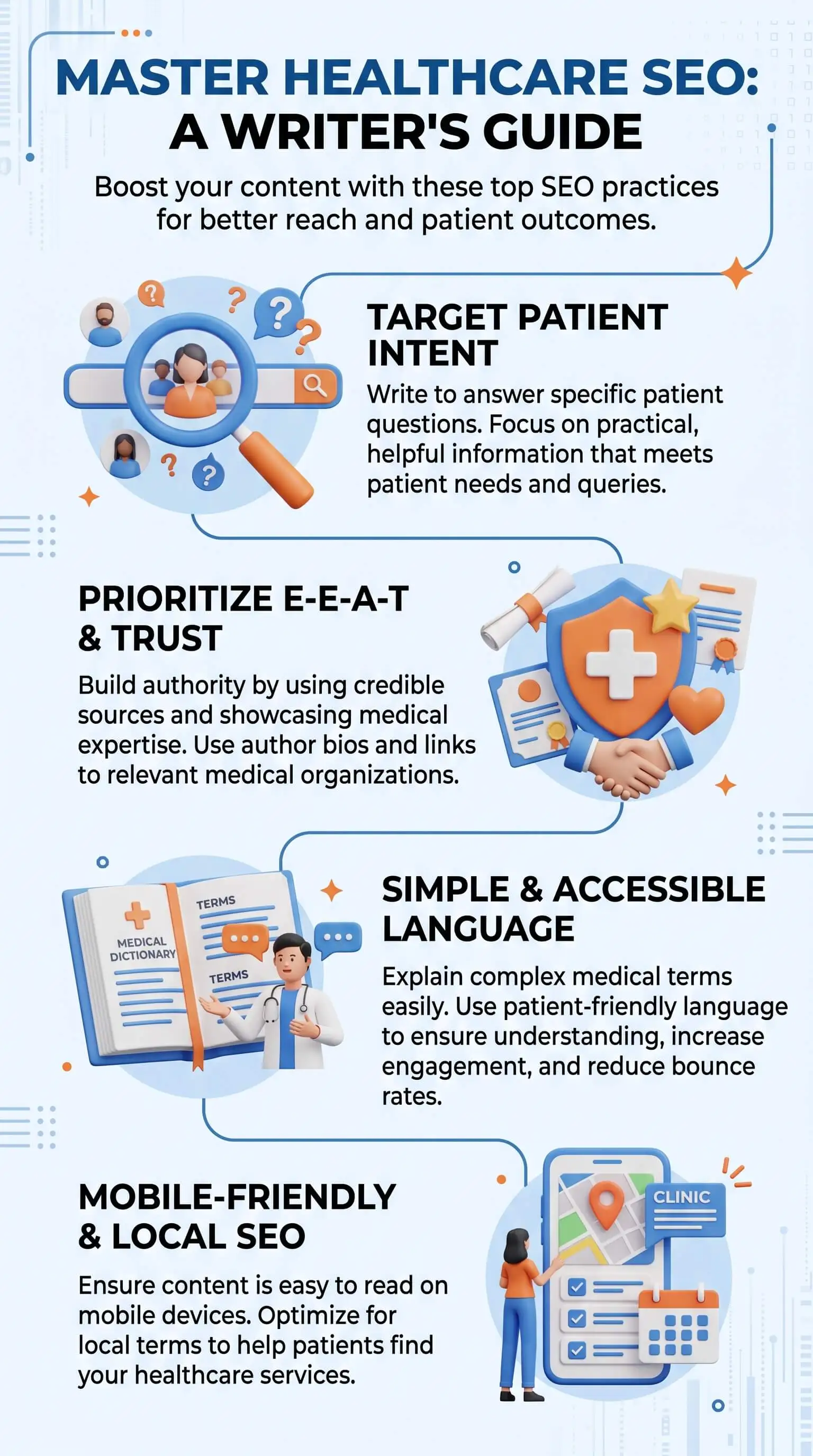
Ranking healthcare content well comes down to a handful of habits, done consistently. None of them are tricks. They’re the things any sharp editor would ask for anyway, lined up with how Google actually judges a page. Here’s where I start, and why each one carries more weight for health topics than for almost anything else you could write about.
Start With Search Intent, Not the Keyword
Before I write a single line, I look at what’s already ranking for the term. If the top results are all clinic pages and the search is “urgent care near me,” no blog post is going to win that spot, and chasing it just burns your time. Health searches usually sort into a few buckets. Someone wants to understand a symptom, weigh treatment options, or find a provider. Match the format to that. An informational search wants a thorough, plainly written explainer. A decision-stage search wants a clear comparison and an obvious next step. Ten minutes reading the live results saves you a week of writing the wrong thing.
Make E-E-A-T Visible on the Page
E-E-A-T stands for experience, expertise, authoritativeness, and trust, and Google holds health content to the strictest version of it. The catch is that the page has to actually show those things. So every health article I write carries a named author byline with relevant credentials, a publish date and an updated date, and citations to primary sources... peer-reviewed studies, government health agencies, the real stuff. Where it fits, I add a line of genuine first-hand perspective, because Google now counts experience as its own signal. If a piece reviews a product or a process, it should read like someone actually used it. Trust is the part you can’t fake, and it’s the part that keeps your rankings steady when a core update rolls through.
Optimize the On-Page Elements, Then Stop
On-page SEO for health content gets simple once you quit overthinking it. Each page gets one clear H1, a logical heading outline, and the main topic worked naturally into the title, the opening, and a couple of subheads. Write the title tag and meta description to be accurate and worth a click, not stuffed. Keywords go in because they belong, not to hit a number. The bigger win is structure: short paragraphs, descriptive subheads, and a straight answer placed near the top. That format helps readers skim, helps Google pull a featured snippet, and helps an AI system grab a clean passage when it builds an answer. Then stop. Anything past that point starts working against the reader, and the reader is who you’re here for.

“The healthcare pages that climb and stay there are rarely the most optimized ones. They’re the ones a nurse, a patient, or a worried parent could read and trust on sight. I’ve watched technically flawless articles lose to plainer pages that simply had a credentialed author, honest sourcing, and a writer who understood the reader’s fear. Write for that person first. The rankings follow. So do the AI citations.”
7 Essential Resources
These are the references I keep open while I work. Bookmark them. Between them, they’ll teach you more about healthcare SEO than any course you could pay for.
Google SEO Starter Guide. Google’s own plain-English rundown of how Search works and which on-page basics actually move the needle. Start here if SEO still feels fuzzy.
Creating Helpful, Reliable, People-First Content. The set of self-check questions Google wants every creator to ask. I run each health draft against this list before it goes live.
Google Search Quality Rater Guidelines. The handbook Google’s human raters work from. It spells out E-E-A-T and YMYL in real detail, which makes it required reading for anyone writing about health.
American Medical Writers Association (AMWA). The professional home for medical communicators, with training, certification, and a network worth joining as you build a healthcare niche.
MedlinePlus. The National Library of Medicine’s consumer health library. I use it to confirm medical claims in language patients can actually follow.
PubMed. The database of peer-reviewed biomedical research. When a health claim needs a primary source, this is where you find it and check it.
PlainLanguage.gov. The federal plain-language standards. Health content falls apart when readers can’t follow it, and these guidelines keep your writing clear.
3 Statistics
A few numbers explain why these habits matter as much as they do. Three of them shape how I approach every health page I write.
The top three results take 68.7% of the clicks. First Page Sage found that the first three organic spots on a Google page pull in more than two-thirds of every click. For a health writer, that one number is the whole game. Page one alone isn’t enough. Land in fourth or fifth and most searchers still never reach you.
AI summaries cut link clicks close to in half. In a 2025 Pew Research Center study, people clicked a traditional link only 8% of the time when an AI summary showed up in results, against 15% when it didn’t. Health questions pull these summaries constantly, so your content has to be clear and well-sourced enough to get quoted inside the answer itself.
77% of health searches start at a search engine. Pew Research Center found that 77% of people looking online for health information begin at a search engine, not a specialist site and not social media. Search is the front door to almost every health topic you’ll write about. That’s why SEO isn’t optional in this work.
Final Thoughts
Here’s what I actually believe after years of doing this: healthcare SEO is swinging back toward honesty, and that’s good news for any writer who cares about the work. For a long stretch, the field rewarded whoever could publish the most pages the fastest. That stretch is ending. Core updates, the helpful-content system, and AI summaries all push the same direction, toward content that demonstrates expertise and earns trust. My honest take is that the freelance healthcare content writers who do well over the next few years won’t be the fastest or the cheapest. They’ll be the ones who can prove experience, explain complicated things in plain words, and build a page so a reader and an AI system can both find the answer fast. And none of it requires gaming the system. It just means writing for the reader, usually someone anxious about their health, the way you’d want someone to write for you. Do that page after page, and visibility stops being a chase. It turns into a byproduct.
Frequently Asked Questions
What does a freelance healthcare content writer do?
A freelance healthcare content writer creates health content for clients on a contract basis: blog posts, website copy, patient education material, and email. The job blends medical research, plain-language writing, and SEO, so the finished piece is accurate, easy to follow, and able to reach the right audience.
Do you need a medical background to write healthcare content?
Not always, though it helps. Plenty of strong healthcare writers come from journalism or English and build their medical knowledge through research, interviews, and expert review. What matters most is rigor: reliable sourcing, accurate explanations, and a clear process for fact-checking sensitive health claims.
How do healthcare content writers optimize content for SEO?
They start by matching the content to search intent, then build in E-E-A-T with credentialed bylines, citations, and current information. They work titles, headings, and keywords naturally, write in plain language, and structure pages with short sections and clear answers, so readers and search engines can both follow along.
What is E-E-A-T, and why does it matter for healthcare content?
E-E-A-T stands for experience, expertise, authoritativeness, and trust. Google’s quality guidelines apply the toughest version of it to health, which it treats as “Your Money or Your Life” content. Pages that show who wrote them, cite solid sources, and stay accurate tend to rank better and hold that rank longer.
How much does a freelance healthcare content writer cost?
Rates swing widely with experience, project type, and complexity. Industry sources commonly cite hourly ranges from roughly 40 to 150 dollars or more, and many writers price by the project instead. Regulated or highly technical work runs higher, since it takes deeper research and careful review.
How do you hire the right freelance healthcare content writer?
Look for relevant healthcare experience, samples that show both clarity and accuracy, and a working grip on SEO and E-E-A-T. Ask how they fact-check medical claims and handle expert review. The right writer makes complicated health topics readable without losing precision.
Your Next Step
Healthcare SEO works like a treatment plan, not a one-time fix. It rewards consistency. Pick your highest-priority page and start there: check the intent, tighten the structure, add solid sourcing and a credentialed byline, then watch what moves. When the stakes are high and the timeline is short, an experienced healthcare content writer or even specialists offering board game copywriting services for health education campaigns is often the difference between a page that ranks and one that quietly underperforms. Either way, choose one page this week and make it better.